11 min read
Why I chose a lifetime offer for my first 100 users
Why pkgr.app sells 100 founder spots at USD 149, paid once, instead of a subscription from day one: the reasoning, the limits, the risks and the refund.
The price of pkgr is four lines in a config file.
export const FOUNDER_SPOTS = 100;
export const FOUNDER_PRICE_USD = 149;
export const STARTER_PRICE_USD = 9;
export const ACCESS_DEADLINE = 'December 31, 2026';
That is the whole file: apps/marketing/src/config.ts. Every page of the marketing site reads those values. Change 149 to 199, rebuild, and the site says 199 everywhere. It takes ten seconds.
I stared at that file for a while before typing the numbers. Not because the numbers were hard to pick. Because I realized a number on a page is not a number. It is a promise. Someone will read “lifetime access”, pay once, and expect me to still be here, still shipping, long after the payment has left my mind. The ten seconds it takes to edit the file have nothing to do with the years the promise lasts.
This article explains why I made that promise anyway, what exactly I am promising, what it costs me, and where I think it can go wrong.
The default is a subscription, and I understand why
Most software like mine sells a monthly plan from day one, and the arguments are good: recurring revenue is predictable and income follows the value users keep getting. I will sell Starter monthly, at USD 9 a month, once the founding wave is over. This is not a rejection of subscriptions.
The problem is timing. pkgr builds, signs and ships iOS apps from the cloud: you push to GitHub, a workflow that pkgr installs builds the app, signs it and delivers it to TestFlight or the App Store. No Mac, no Xcode. But it asks a stranger to do something delicate. They connect a repository, they let me store a signing certificate, and they trust a tool they found a week ago with the path between their code and the App Store.
Asking that person for a recurring payment on day one asks for the most trust when I have earned the least. Nobody has yet seen a TestFlight upload simply work. A subscription button on a brand new product says “pay me every month, then see if you like it”. Even with a cancel button, that is the wrong order.
A price is a promise, so I looked at what I could promise
What changed my thinking was a change of question. I stopped asking what the product is worth and started asking what I can honestly commit to.
A monthly price promises a service for thirty days and leaves you free to go. That is a light promise on both sides. A lifetime price promises something heavier: that I keep this plan alive as long as the product exists. A heavier promise should be made to fewer people, at a time when their trust is worth more to me than their money.
That is the whole logic. Trust comes before revenue, and early feedback is worth more than early cash. If a hundred people run real apps, with real certificates and real Apple accounts, through pkgr, they will find what I cannot find alone: the expired provisioning profile, the export-compliance step I explained badly, the build number that conflicts with one already on TestFlight. A hundred real projects are a better test suite than any I can write. Someone who paid once tends to write the long, specific bug report. Someone who resents a monthly charge may leave in silence.
So the real currency of the founding wave is feedback. The USD 149 is a way to select people who mean it, and to give them a fair deal in return.
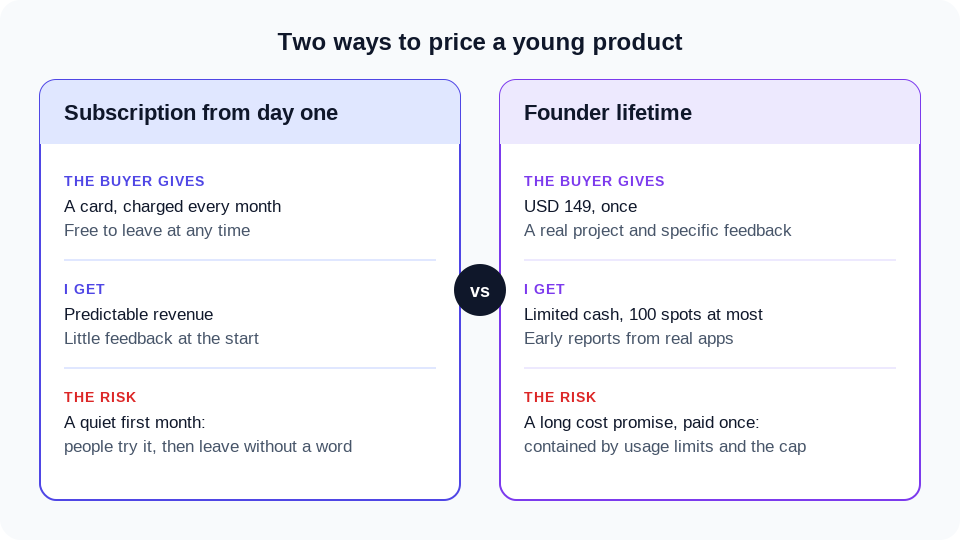
I drew the trade as a balance because that is how I think about it. Read the diagram from the bottom row. The subscription path risks a quiet first month: people try the product, hesitate, and leave without telling me why. The lifetime path risks something different: I take the money once and carry the cost for years. I picked the second because its risk can be limited with rules, while silence cannot.
What the USD 149 buys
Vague lifetime offers are where trust goes to die, so I want to be exact.
You get the Starter plan, for life, for one payment of USD 149. Not every future plan. Not unlimited use. Starter, with Starter’s limits. The FAQ on the early access page says almost these words, and I wrote them that way on purpose.
The Free plan comes first, and it is real. Every account starts there: one project, signed staging builds on every push that you install over the air on your iPhone, the certificate vault and signing wizard, analytics for the current month, and an install window of 7 days. You see your own app signed and running on your phone before paying anything. I did not want that step behind a payment.
Starter is where the road continues to the store: production builds signed for the App Store, deployment to TestFlight and App Store Connect, submission for review, automatic App Store screenshots, up to 5 projects, full analytics history, and a 30-day install window for staging builds. These numbers come from the plan quotas in the API.
The math on the early access page is meant to be honest, not flattering. At USD 9 a month, the founder price pays for itself in month 17. Keep shipping one app for three years and the monthly plan costs USD 324 against USD 149 once. But if you ship a single app for a few months, the monthly plan costs less, and the page says so. A founding spot is for people who plan to keep updating apps. I would rather lose a sale than sell the wrong thing.
How the lifetime access works in the code
Here I try not to oversell my own engineering.
When you click “Claim a founding spot”, you create an account or sign in, and the API opens a Stripe Checkout session in one-time payment mode, with its own dedicated price, not the monthly one. The session is marked as the founder purchase and tied to your account. No renewal is scheduled, because there is nothing to renew.
When Stripe confirms the payment, the server sets the plan on your account to Starter and detaches it from any subscription. You return to your Billing page with Starter already active. The Stripe webhook and the success page can both apply the same payment, and applying it twice gives the same result, so a slow network does not leave anyone half-upgraded.
That is all “lifetime” means technically: your account holds the Starter plan, and nothing in the billing flow is set to take it away on a date. It is not a license key. It is a plan on an account, written by the server after a verified payment. I prefer it boring. Only two things remove it, and I describe both openly below: a refund I honor, and a payment dispute with the bank.
You can pay by card through Stripe, or in USDC on Arbitrum One. The crypto path is manual: you email me the transaction hash, I check it on-chain by hand, then switch the account to Starter. The page warns that crypto transfers cannot be reversed, because people should know that before sending money.
The cost I take on
Here is the part that keeps me honest. A lifetime promise is a long commitment to costs, and I do not get a monthly payment to cover them.
Your builds run through the GitHub Actions workflow in your own repository, so build compute is not on my invoice. Everything else is. The API runs on a VPS. Firestore holds the data. Firebase Storage holds the hosted artifacts that let you install a staging build over the air. A Redis queue runs background jobs. Add screenshot capture, live build logs, email, monitoring, and my time answering people.
This is why usage limits exist. Every limit on Starter is a cost fence. Five projects keep one account from growing without bound. The 30-day window on hosted staging artifacts means a daily sweep deletes the hosted copy of an old build instead of storing it forever. Lifetime access to a plan without limits would be a blank cheque signed by me. Lifetime access to a plan with limits is a bet I can price.
The second fence is the cap. One hundred spots is a number I can reason about: I roughly know the load if every spot were used to the limit. A thousand lifetime spots would be a different and riskier promise.
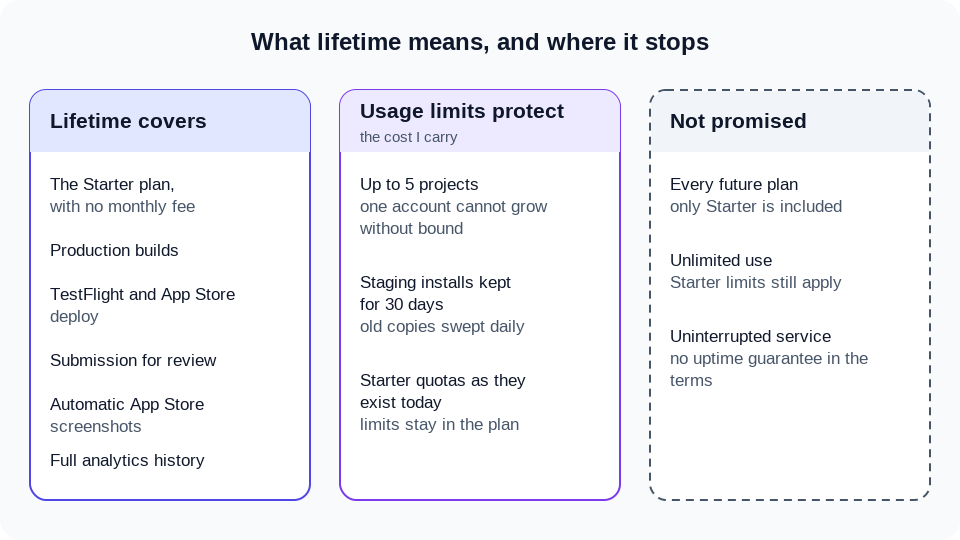
One harder point, since I would want it answered if I were buying. A lifetime promise is about a product, not about eternity. If pkgr ever stopped existing, the plan would stop with it. I cannot fix that with a clause, only by doing the work well for a long time.
How the 100 spots are counted
The cap is communicated, not yet mechanical. I want to say that plainly.
The number 100 lives in the config file at the top of this article, and it drives every sentence on the site about spots. The early access page says the price is available for 100 spots in total, and that they close once they are gone or once pkgr.app opens to the public, whichever comes first. In the code, no counter stops the checkout at the hundredth payment. I close the offer myself when the hundredth spot is taken at the time of publication.
I would rather tell you that than let you assume a clever lock exists. For a number this small, a hand count is enough.
The funnel and the safety net
The path to a spot is short on purpose: a visitor reads the page, creates an account, pays through Stripe Checkout, and lands back in the dashboard with Starter active. The account comes before the payment so the spot is attached to a real person from the first second. You can also start on Free and claim a spot later from the Billing page, if spots remain.
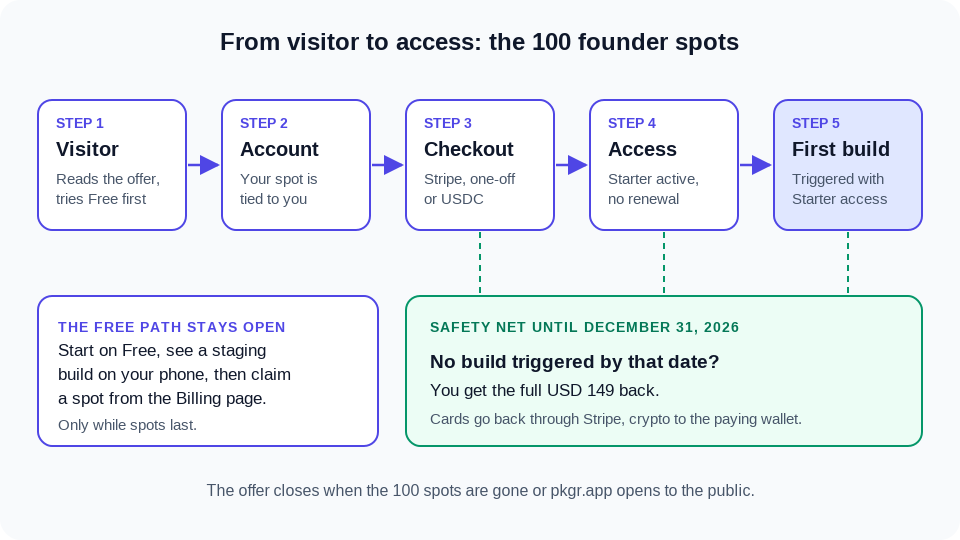
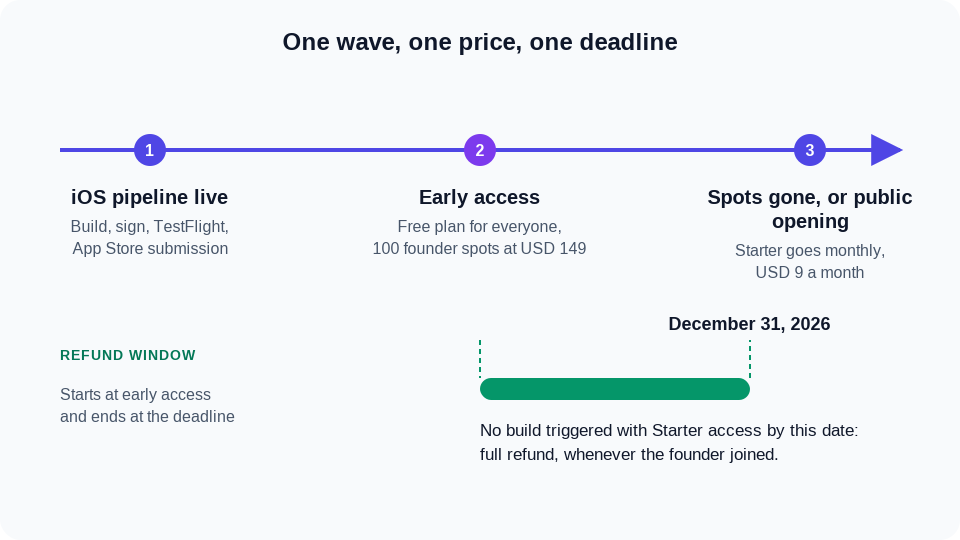
Under the funnel runs the guarantee. If you have not triggered at least one build with your Starter access by December 31, 2026, you get all USD 149 back. Cards are refunded through Stripe, crypto to the wallet you paid from. It is written in my terms of service, which is where it needs to be to count.
The guarantee is tied to building, not to being happy. It removes the fear of paying for something you never get to use. If you bought a spot and never ran a build, the product did not do its job for you, and you should not be out of pocket.
One honest detail on mechanics. The terms and the page promise the refund. At the time of writing, the repository does not contain a scheduled job that issues these refunds once the deadline has passed. The check is a plain question to the build history (did this account run at least one build?) and the refund itself goes through Stripe, but the step connecting the two is a commitment I owe, not code already running. I prefer to write that sentence than to let “automatically” sound more finished than it is.
Billing risk is part of the offer
One thing scares me more than usage costs: card disputes. Stripe watches the ratio of disputes to payments on an account. With few transactions, one dispute weighs heavily. If a hundred founders pay once and a single one disputes the charge with their bank, that is one percent, above the level where Stripe starts to look closely at an account. So I treated billing risk as part of building the offer.
In practice, the API reacts to the signals Stripe sends. An early fraud warning triggers an immediate refund and pauses further purchases on that account. A dispute removes paid access and pauses purchases until I have looked at the case myself. A daily job reads dispute, fraud, refund and failed-payment rates from Stripe and compares them to thresholds I set below those of Stripe and the card networks, so I hear about a drift early. An admin page lists open disputes with their deadlines. When one opens, the page prepares a draft of the evidence from the payment and the build history, and nothing goes to the bank until I have read it and confirmed.
The downsides, stated openly
Every lifetime offer has a shadow, and I would rather describe mine.
The first risk is future revenue. Every founder is someone who will never pay USD 9 a month. If pkgr grows, those hundred accounts cost me money every month and bring none. A lifetime offer sells a slice of the future now at a fixed price. That is the trade, and I accept it with open eyes.
The second risk is attention. Under pressure, a “paid once” user can start to feel like a user who no longer matters for revenue. If I stop listening to the founders, I have wasted the offer.
The third is the ceiling. A hundred payments of USD 149 add up to at most USD 14,900, before payment fees and taxes. That is a ceiling, not a forecast, and nobody should read it as a revenue number. It is about sixteen and a half months of what a hundred monthly subscribers would pay, collected up front. It buys focus for a while. It does not fund a company.
The fourth I cannot remove: I might misjudge the cost of keeping the promise. The cap and the usage limits contain that risk but do not cancel it. If I am wrong, I would rather say so openly than quietly narrow what “lifetime” means.
What each side gets
The buyer gets Starter without a monthly line on a card statement, a price that does not move, a refund path written down, and a direct line to the person building the tool. The email address on the site goes to me, and a human replies.
I get a hundred people who care enough to pay before the product is famous, real apps going through a real pipeline, and honest reports on what is broken. I also get a clear end to the offer. After the hundredth spot, or when pkgr opens to the public, Starter becomes the monthly plan at USD 9 a month, as the page says at the time of writing.
If it sounds right to you
The offer fits a particular person: someone who ships iOS apps from JavaScript code on GitHub, plans to keep updating them for a while, and is fine with an early product that still moves fast. If that is you, start on the Free plan, which costs nothing. Connect a repository, run a staging build, and see it on your own phone. If it works, a founding spot is USD 149 paid once, for Starter for life, with Starter’s usage limits, and a full refund if you have not triggered a build by December 31, 2026.
Everything is at pkgr.app/early-access.
Keep reading
If you want to see how I think when the problem is technical rather than commercial, read what I learned automating iOS code signing. Once the founding wave is underway, I will write down what the first founders changed in 100 spots: what the first founders changed.